Queer Places:
Golders Green Crematorium, 62 Hoop Ln, London NW11 7NL, United Kingdom
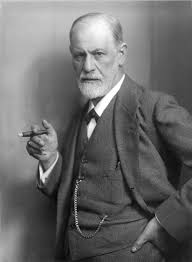 Sigmund Freud (May 6, 1856 - September 23, 1939), born Sigismund Schlomo Freud on May 6, 1856, in the small Moravian town of Freiberg (now Příbor in the Czech Republic), was
an Austrian neurologist and the founding father of psychoanalysis, a revolutionary clinical method and theory for evaluating and treating the human psyche. Raised in a
Jewish family that relocated to Vienna when he was four years old, Freud displayed high academic brilliance early on, leading him to enter the University of Vienna in 1873
to study medicine. After initially pursuing physiological and neurological research—including notable work on the nervous systems of lower aquatic organisms and human brain
anatomy—he earned his medical degree in 1881. Financial pressures and his upcoming marriage to Martha Bernays prompted him to transition into active clinical practice, where
he took up a position at the Vienna General Hospital.
Sigmund Freud (May 6, 1856 - September 23, 1939), born Sigismund Schlomo Freud on May 6, 1856, in the small Moravian town of Freiberg (now Příbor in the Czech Republic), was
an Austrian neurologist and the founding father of psychoanalysis, a revolutionary clinical method and theory for evaluating and treating the human psyche. Raised in a
Jewish family that relocated to Vienna when he was four years old, Freud displayed high academic brilliance early on, leading him to enter the University of Vienna in 1873
to study medicine. After initially pursuing physiological and neurological research—including notable work on the nervous systems of lower aquatic organisms and human brain
anatomy—he earned his medical degree in 1881. Financial pressures and his upcoming marriage to Martha Bernays prompted him to transition into active clinical practice, where
he took up a position at the Vienna General Hospital.
A pivotal turning point in Freud’s career occurred in 1885 when he traveled to Paris on a fellowship to study under the renowned neurologist Jean-Martin Charcot at the
Salpêtrière Hospital. Charcot’s demonstrations of the psychological, rather than purely organic, roots of hysteria profoundly altered Freud’s intellectual trajectory.
Returning to Vienna, Freud collaborated with physician Joseph Breuer, with whom he developed the "talking cure" or cathartic method. This collaboration birthed
psychoanalysis, a framework centered on uncovering repressed unconscious material, analyzing dreams, and navigating free association. In 1900, Freud published his seminal
work, The Interpretation of Dreams, which solidified his intellectual standing, followed by other major treatises such as Three Essays on the Theory of Sexuality (1905) and
The Psychopathology of Everyday Life. Despite initial academic hostility and professional isolation due to his radical focus on sexuality and the unconscious, Freud gathered
an inner circle of devoted disciples, though theoretical disagreements eventually led to high-profile schisms with figures like Carl Jung and Alfred Adler. As the political
landscape of Europe darkened and the Nazi party annexed Austria and targeted Jewish intellectuals, Freud and his family fled Vienna in 1938 to find refuge in London. There,
plagued by a painful, long-term cancer of the jaw and palate resulting from decades of heavy cigar smoking, he died on September 23, 1939.
Freud’s relationship with and legacy regarding LGBTQ+ concepts—historically categorized under discussions of homosexuality, inversion, and bisexuality—are deeply complex,
historically progressive for their time in certain respects, yet laden with pathologizing assumptions from a modern perspective. Freud rejected the widespread contemporary
moralistic and legal view that homosexuality was simply a malicious sin, a criminal degeneracy, or a congenital degeneration. Instead, through his foundational concept of
universal human bisexuality, Freud argued that all human beings begin life with unchanneled, polymorphic sexual drives and potential object-choices that are not inherently
restricted to the opposite sex.
This nuanced perspective is famously highlighted in Freud’s 1935 "Letter to an American Mother," written in response to a distressed woman asking him to cure her son's
homosexuality. In the letter, Freud famously asserted that homosexuality is assuredly no advantage, but it is no vice, no degradation, and no classification of illness;
rather, it is a variation of sexual function produced by an arresting of sexual development. Freud maintained that psychoanalysis could rarely convert a homosexual person
into a heterosexual one, because the homosexual object-choice had become deeply rooted and fixed as part of the individual’s psychic structure.
However, Freud's broader structural model concurrently framed exclusive homosexuality as a developmental deviation or an outcome of arrested psychosexual
maturation—frequently tied, in his male-centric framework, to an unresolved Oedipus complex involving an intense attachment to the mother and the displacement of the father.
While he championed a clinical tolerance that separated psychoanalytic treatment from legal persecution and moral condemnation, his theoretical insistence that
heterosexuality represented the ultimate endpoint of normal psychological development laid the groundwork for decades of mid-20th-century psychoanalytic orthodoxy that
pathologized queer identities. Nevertheless, his insistence that sexuality is fluid rather than strictly binary, and his foundational explorations into the complexities of
human desire, provided early conceptual tools that later queer theorists and modern psychologists both critiqued and utilized to dismantle normative assumptions about gender
and sexuality.
References:
- Freud, Sigmund. (1900). The Interpretation of Dreams (Die Traumdeutung). Leipzig: Franz Deuticke.
- Freud, Sigmund. (1905). Three Essays on the Theory of Sexuality (Drei Abhandlungen zur Sexualtheorie). Leipzig: Franz Deuticke.
- Freud, Sigmund. (1920). Psychogenesis of a Case of Homosexuality in a Woman (Über die Psychogenese eines Falles von weiblicher Homosexualität).
- Freud, Sigmund. (April 9, 1935). "Letter to an American Mother." First published in The American Journal of Psychiatry (Vol. 107, No. 10, April 1951, provided via Alfred Kinsey).
- Jones, Ernest. (1953–1957). Sigmund Freud: Life and Work (3 Volumes). New York: Basic Books.
- Gay, Peter. (1988). Freud: A Life for Our Time. New York: W. W. Norton & Company.
- Makari, George. (2008). Revolution in Mind: The Creation of Psychoanalysis. New York: HarperCollins.
- Oosterhuis, Harry. (2000). Stepchildren of Nature: Krafft-Ebing, Psychiatry, and the Making of Sexual Identity. University of Chicago Press.
Support this project
This website is a passion project researched, developed, and funded entirely by me. If you find the content valuable and would like to help support the ongoing research and hosting costs, any contribution is deeply appreciated.
Thank you for keeping this independent resource alive!
My books on Amazon: Elisa Rolle's books
BACK TO HOME PAGE